Most data residency conversations begin in the legal team and end there. A regulator publishes a localisation requirement. Legal reads it. Legal informs the business that data must stay within a jurisdiction. The business instructs IT to make it so. The matter is considered closed.
This sequence is wrong, and it produces consequences that neither the legal team nor the regulator anticipated.
Why legal framing is insufficient
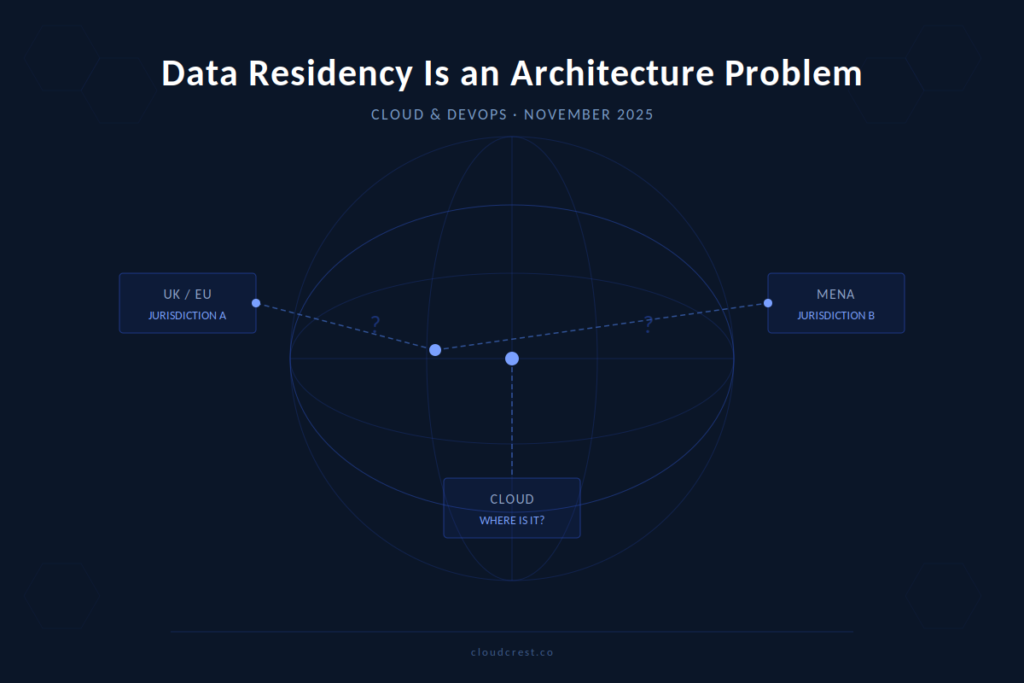
Data residency requirements exist on paper as jurisdictional constraints. In practice, they are architectural problems. Where data lives determines how it can be processed, how it can be protected, how it can be recovered, and what dependencies it carries with it.
A legal team can confirm whether a given configuration satisfies the letter of a regulation. It cannot assess whether that configuration is operationally viable, secure, or consistent with how the organisation’s systems actually function. When those assessments are skipped, residency compliance becomes a point-in-time declaration that degrades the moment the architecture evolves.
This happens frequently. Data is localised. The localisation is documented. Six months later, a new service is introduced, a third-party integration is added, or a cloud configuration changes and the data quietly moves. Nobody has violated the intent deliberately. Nobody has checked whether the compliance posture held.
The architecture decisions inside every residency requirement
Behind every data residency requirement is a set of architecture choices that must be made deliberately.
The first is scope definition. Residency requirements apply to specific data categories, not to all data uniformly. Mapping regulatory requirements to data classifications, then to system components, then to cloud regions or on-premises infrastructure requires architectural knowledge that legal teams typically do not hold.
The second is processing versus storage. Many residency frameworks specify where data must be stored. They say less about where it may be processed. The distinction matters enormously for cloud-native architectures, where processing and storage are often separated by design. Compliance with storage requirements while processing data in a different jurisdiction produces a gap that regulators are increasingly alert to.
The third is the dependency chain. Data does not sit still. It flows between systems, is copied for backup, is replicated for resilience, and is accessed by services that may operate from different locations. Each of these movements is an architecture decision. None of them is visible to a legal analysis of the regulation’s text.
What this costs organisations
The cost of treating residency as a legal problem rather than an architecture problem is not immediately visible. It accumulates.
Compliance postures are declared and not maintained. Architecture changes invalidate them silently. When regulators examine the actual data flows, not the documented intent, they find divergence. The organisation cannot explain why. It can only produce the original legal sign-off, which confirms what the decision-makers believed at the time, not what the system is actually doing.
This is increasingly the pattern that triggers enforcement. Not deliberate non-compliance. Compliant intent, poorly translated into architecture, with no mechanism for ongoing validation.
What a better approach looks like
Organisations that manage residency well treat it as a continuous architecture concern, not a one-time legal determination.
They map regulatory requirements to data classifications and then to system components, accepting that this mapping must be revisited whenever the architecture changes. They involve cloud architects and security teams in residency decisions from the outset, not after legal has already formed a view.
They also distinguish between compliance documentation and compliance validation. Documenting where data is supposed to be is not the same as verifying where it actually is. The former is a legal exercise. The latter is an engineering one.
Data residency is not a legal checkbox. It is a sustained architectural discipline. Organisations that treat it as the former will find that their compliance posture is fragile in exactly the ways that matter most when regulators start asking questions about actual data flows, not intended ones.