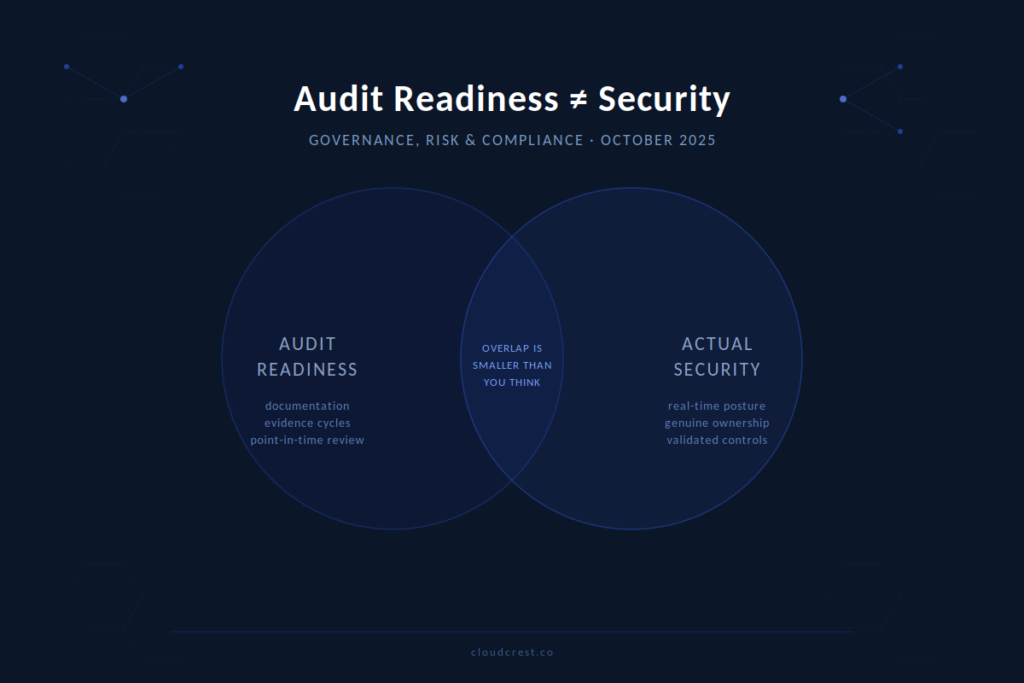
Audit readiness and security are not synonyms. Organisations that have spent years optimising for the former often discover, at the worst possible moment, that they have been neglecting the latter.
This distinction is not academic. It shapes how resources are allocated, how risks are framed, and how leadership interprets the health of the organisation’s security posture. When the two are conflated, the result is a system that performs well in controlled reviews and fails under real conditions.
The audit optimisation trap
Audits have defined scope. They examine specific controls, specific time periods, and specific evidence types. Organisations learn this quickly. Over time, compliance functions become highly efficient at producing the right evidence at the right time for the right review cycle.
What this process does not test is whether the controls work outside the audit window. It does not assess whether the evidence reflects actual behaviour or rehearsed behaviour. It does not ask whether the risks that matter most to the organisation are the same ones the audit framework was designed to examine.
In practice, audit readiness is a performance. Security is a state. They can coexist, but they require different disciplines to maintain and different measures to evaluate.
Where the gap becomes visible
The gap between audit readiness and actual security tends to surface in predictable places.
The first is incident response. Organisations that have passed repeated audits sometimes discover during an actual incident that their documented processes do not reflect how decisions are made under pressure. Roles that existed on paper are unexercised in practice. Escalation paths assume a level of institutional memory that has eroded through turnover.
The second is scope creep. Audit frameworks examine what they were designed to examine. Modern operating environments such as cloud-native architectures, third-party dependencies, AI-assisted processes often introduce risk surface that frameworks have not yet caught up with. Audit readiness in legacy terms does not translate to security in current terms.
The third is ownership fragmentation. Audit evidence is gathered. Controls are attributed to teams. But the actual accountability for whether a control works, degrades, or fails often belongs to no one in particular. Auditors find the documentation satisfactory. Regulators, when they arrive, find the accountability structure hollow.
What security actually requires
Security, as a state rather than a performance, requires ongoing validation against real conditions as opposed to a recurring review against a fixed standard.
It requires that the controls which matter most are identified deliberately, not inherited from a framework without consideration of organisational context. It requires that ownership is genuine that the people named as accountable have the authority, knowledge, and continuity to exercise that accountability when something goes wrong.
It also requires that leadership understands the difference. Boards and executive teams that equate a clean audit with a secure organisation are making a category error. Auditors are not adversaries probing for failure. They are sampling against known criteria. The absence of findings tells you that the sample was clean. It says little about what the sample did not cover.
The implications for decision-makers
Organisations that take this distinction seriously tend to reach a few uncomfortable conclusions.
First, that compliance investment and security investment are not the same budget line. Treating them as interchangeable produces an organisation that is well-documented and poorly defended.
Second, that the metrics used to report on security posture to leadership may be measuring the wrong things. Audit findings, control coverage percentages, and certification status describe compliance performance. They do not describe security effectiveness.
Third, that the expectation of regulators is shifting in this direction. Supervisory bodies increasingly distinguish between organisations that are compliant and organisations that are secure. The former is table stakes. The latter requires a different kind of investment, a different governance model, and a different relationship between the compliance function and the rest of the business.
Audit readiness matters. It is not optional. But it is a floor, not a ceiling. Organisations that treat it as the ceiling tend to find out eventually that the building was taller than they thought.